THE STATE OF EDUCATION IN NIGERIA AND THE NEW STUDENT LOAN POLICY

Politics

Education is an important process in our development as humans. It is distinct from schooling. Schooling is just one of the ways in which education is provided, whereas education is concerned with the total process of human learning by which knowledge is imparted, faculties are trained and different skills are developed.

Education can also be defined as the act or process of educating or applying discipline on the mind of individuals. It is a dynamic instrument of change. According to Bamisaiye (1989), Education is “ a cumulative process of development of intellectual abilities, Skills and attitudes, all of which form our various outlooks and dispositions to action in life generally” (p. 9) education is the pristine essence of learning which makes us permanently able and disposed to benefit ourselves and other members of the society in the use we make of such learning. Schooling may lead to negative behavior, knowledge can be negatively used, learning too can also be negative, but education must be positive.

The type of school attended do influence one’s behavior. One can succeed in carrying out a negative, anti-social behavior like “pen-robbery”, armed robbery, examination malpractices, raping, or activities of secret cult members in higher institutions which are acquired through negative learning, but for one’s behavior to have educational worth, it must be positive.

Education as an act or process of being educated can be seen as transmission of knowledge, skills, character traits from educated personnel like scholars, lecturers, teachers etc to those who are lacking it in the society, especially the young ones.

This is done in betterment of their lives as to build them into important and an acceptable individuals in the society.

Some definition of Education by some scholars.
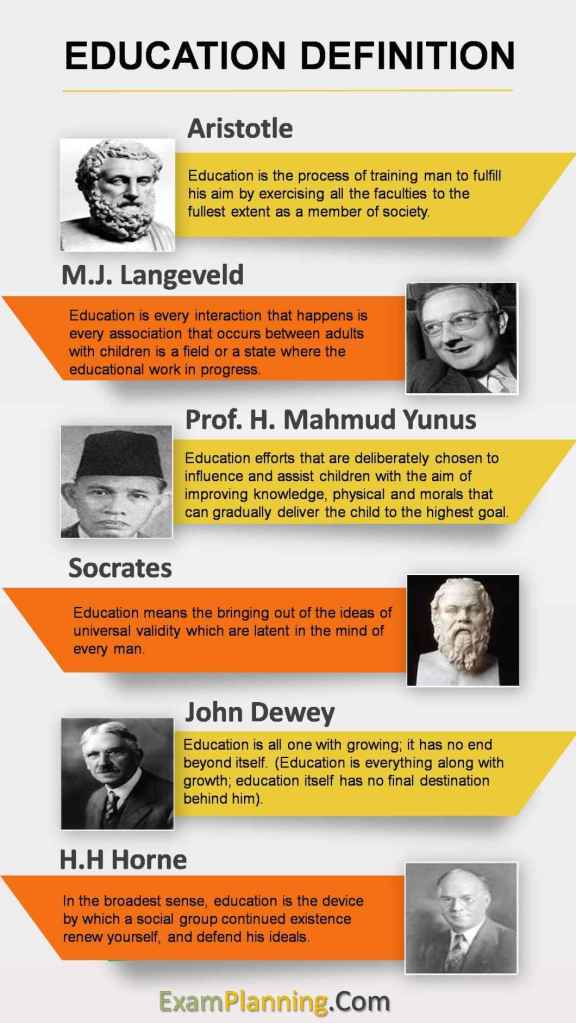
Education scholars

With these scholars, education can be defined and seen from different angle and perspectives. The definition varies depending on each other’s point of view. And with these definitions, our minds will be open on how to define education.

The State Of Education In Nigeria
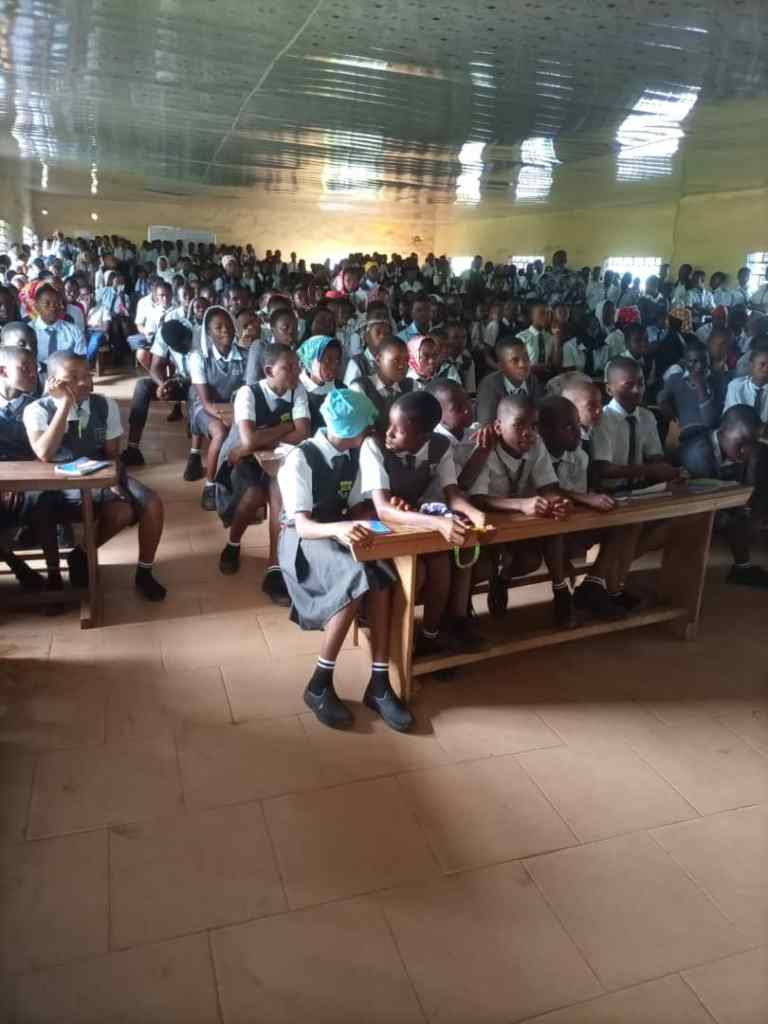
Nigeria, a West African country on the Gulf of Guinea, has many natural landmark and wildlife reserves. Protected areas such as Cross River National Park and Yankari National Park have waterfalls, dense rainforest, savanna and rare primate habitats. One of the most recognizable.
Nigeria has a diverse geography, with climates ranging from arid to humid equatorial. But the most diversed feature of Nigeria is its people.

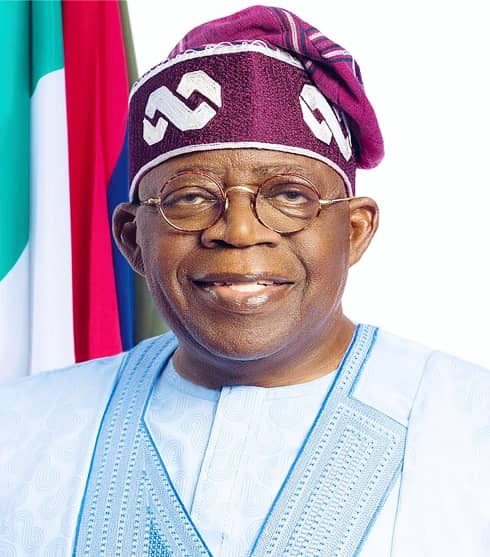
Alot of languages are spoken in the country but it has 3 major ethnic groups which are: Hausa, Igbo and Yoruba followed by others like Tiv, Edo, Ibibio etc. The country is blessed with alot of natural resources, among them are the Crude oil, Mineral, Coal etc.It is a country under the government of His Excellency President Asiwaju Ahmed Bola Tinubu and its capital located in Abuja which is in the North Central. It has two legislative bodies: Senate with 109 members and House of representatives with 360 members.

As a British Colony up till 1960, the system of Education in Nigeria could not but derive from the British system. Even the curriculum was British, and it was only on the eve of independence that people began to question the relevance of the existing curriculum to a Nigerian environment. There were several attempts at making the curriculum relevant – attempts which culminated in the National Curriculum Conference of 1969. The Federal Government set up a Committee in 1973 to study the recommendations of that conference.

Government’s views on the report of the committee were published in 1977 in a White Paper entitled “National Policy on Education”. This Policy was revised in 1981 to reflect the provisions of the Nigerian Constitution of 1979.

The formal Education structure of Nigeria’s National Policy on Education is usually referred to as “the 6-3-3-4 system of Education” because it provides for six years of Primary Education, followed by three years of Junior Secondary Education, three years of Senior Secondary Education and Tertiary Education of varying periods, provided a first degree in a University shall be of not less than four years duration.

Education is important for the development and growth of any nation, including Nigeria. However, the state of education in Nigeria has been a major concern years decades. Despite being the most populous country in Africa and having the largest economy, Nigeria has one of the lowest literacy rates in the world, with only 59% of the adult population able to read and write.

Some of the challenges facing education system in Nigeria are as follows.

• Lack of proper funding: One of the challenges facing education system in this country is the lack of funding by the government. Despite the promises of the government to allocate 26% of its yearly budget to education, this has not been successful, with the educational sector receiving getting less than 10% of the budget in recent years (UNESCO, 2021). This brought about lack of teachers, facilities, resources and low salaries for teachers as well.

• Low Teacher Quality: Nigeria also faces a challenge with low teacher quality, with many teachers lacking the necessary qualifications and training. In addition, there is a shortage of teachers, especially in rural areas, where many schools have few or no qualified teachers. According to UNESCO (2021), Nigeria needs an additional 277,537 teachers to meet the minimum requirement for teacher-pupil ratio.

• Curriculum Issues: The Nigerian education system’s curriculum has been criticized for being outdated and irrelevant to the country’s needs. This has resulted in a mismatch between the skills acquired by graduates and the skills required by the job market, leading to high levels of unemployment among Nigerian graduates (Ibe, 2019).

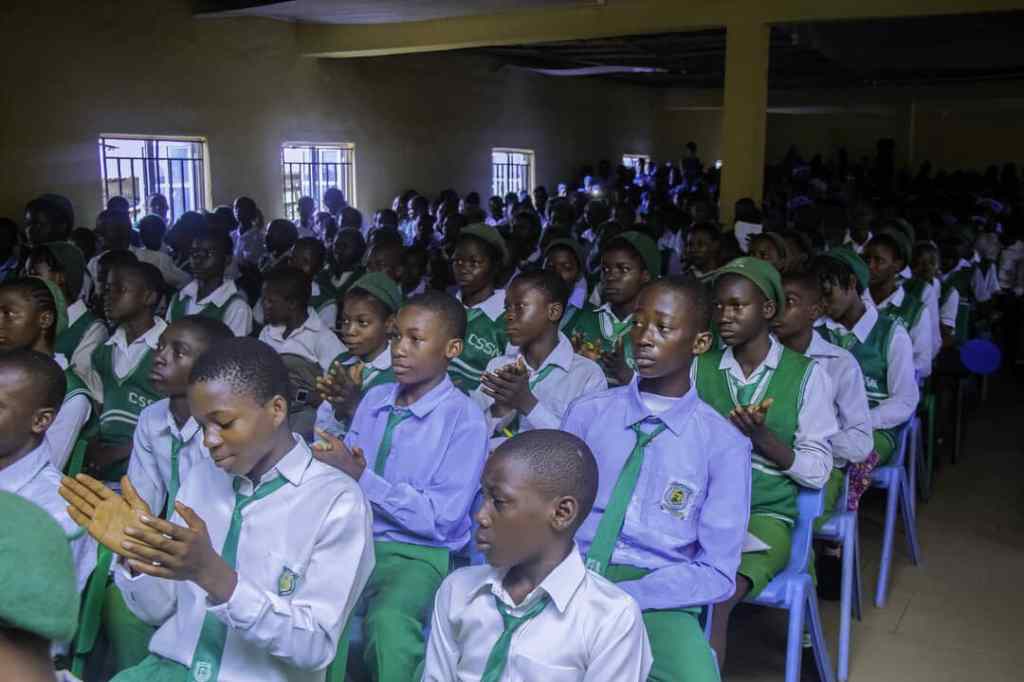
• Lack of proper infrastructure: The educational system in Nigeria suffers from lack of infrastructure with alot of schools lacking basic facilities such as classrooms, chairs, desks, books e.t.c. This has resulted in overcrowding, with some classrooms having up to 100 students per teacher (Oyebade, 2020). Also, some schools lack basic amenities such as water, electricity, and this make it difficult for the school to give students quality education.

SOLUTIONS TO THE CHALLENGES

• Increased Government Funding.

• Quality Teacher Training.

• Curriculum Reform.

• Embracing Technology: Nigeria has a high level of mobile phone penetration, with over 140 million active mobile phone lines (NCC, 2021).

This presents an opportunity to leverage technology to improve education delivery, especially in areas where there is a shortage of teachers. Technology can be used to deliver e-learning platform distance learning, and online courses to students, improving access to education.

Author: Group 7

Visit the link, for more details on good education standard. studentsgalaxy.school.blog
THE NEW STUDENT LOAN POLICY IN NIGERIA

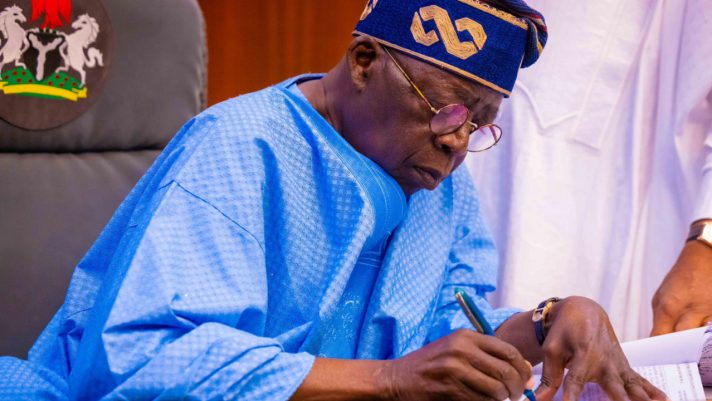
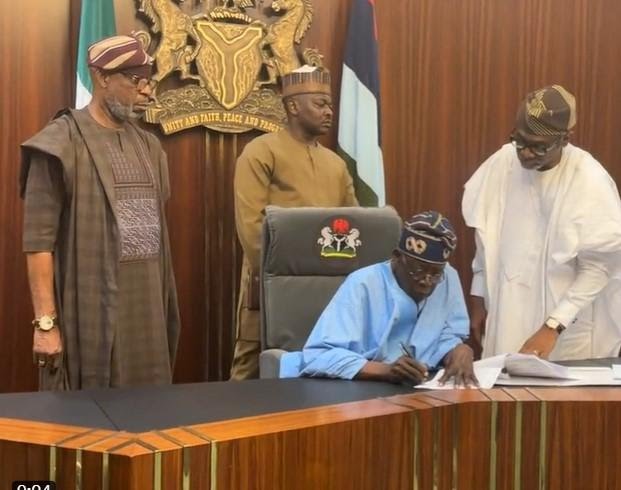
The bill for new student loan policy was signed into law on the 12th of June 2023 by The President and Commander-in-Chief of the Armed Forces of the Federal Republic of Nigeria, His Excellency, Asiwaju Bola Ahmed Tinubu, GCFR. The Students Loan Act becomes President Tinubu’s second piece of legislation signed since he assumed office on the 29th of May, 2023.

The bill would enable indigent students to access loans at interest-free rates.
This bill was sponsored by the Speaker of the 9th House of Representatives, Mr. Femi Gbajabiamila and passed the third reading at the House on May 25, 2023.

According to Mr. Alake, who was accompanied by other members of the media team, including Mr. Tunde Rahman and Mr. Abdulaziz Abdulaziz, and the Permanent Secretary, Ministry of Education, Mr. Andrew David Adejoh, the new law mandates prospective beneficiaries to show proof of their origins.
“We’re very happy to announce to you that today the President, His Excellency, Bola Tinubu, signed into law the Student Loans Bill.

“This is a promise made during the presidential campaign by the then candidate, His Excellency Bola Tinubu, that he will bring back the student loans issue onto the front burner.
“And today, that promise he made has been kept. He has just signed that bill into law, which henceforth would allow or enable our indigent students to access Federal Government’s loans to fund the educational pursuit or career,” Mr. Alake said.

The new law provides easy access to higher education for Nigerians through interest free loans through the Nigerian Education Bank with a view to provide education for all Nigerians. According to the act, all students seeking higher education in any public institution of higher learning in Nigeria shall have equal rights to access the loan without any form of discrimination arising from gender, religion, tribe, position or disability of any kind. The Act also stipulates that the loan shall be granted to students only for the payment of tuition fees.

HOW TO ACCESS AND GET THE STUDENT LOAN.

The law of student loan provides interest-free loans to indigent students in Nigeria. The following must be noted before applying the students loan.

• Students must apply to the Chairman of the Education Bank through their respective institutions and an applicant’s income or family income must be less than N500,000 per annum.

• Applicant must provide, at least, two civil servants as guarantors: of not less than 12 years in service.

• An applicant can also provide a lawyer with at least 10 years post-call experience; a judicial officer; or a Justice of Peace as a guarantor too.

• Students who have defaulted on previous loans, or are found guilty of exam malpractices, felony, or drug offenses will not be considered.

• All applications will be submitted through the Students Affairs Office of each Institution via a list of all qualified applicants from the institution accompanied by a cover letter signed by the Vice-Chancellor or Rector or the head of the institution and the student affairs.

HOW TO REPAY THE LOAN.

The Act stipulates that a beneficiary will begin repayment two years after completing the mandatory one-year National Youth Service Corps (NYSC) scheme by having 10% of his/her monthly salary deducted into a designated bank account. Defaulting or aiding to default will attract a fine of N500,000 or two years imprisonment or both.

CHALLENGE OF THE STUDENT LOAN.

• Funding for the scheme will be from one percent levies from the Federal Inland Revenue Service (FIRS), the Nigeria Immigration Service (NIS), and one percent from oil profits, This sounds very vague. The only good news in the Act is the sound of disbursement timeframe: it says application and disbursements are made within 30 days of the application reaching the chairman of the committee. However, that sound is distorted by the inhumane conditions that come with the loan.

• It could be argued that the conditions are designed to discourage would-be applicants. First, for the combined family earnings to be less than N500,000 annually, parents must earn less than N30,000, which is less than the minimum wage. Besides cutting off several would-be beneficiaries, this group cannot get tax receipts (a requirement) to tender, since this low wage cannot be taxed. That is a grave pointer to the plans (or lack of one) the Federal Government has for the masses.

• Another challenge is the list of offenses that disqualify applicants. These automatically disqualify many that are reformed and seek help to get educated and be set on the right part.

To explore more, niajagist.net.com

Publish by group 7

THE STATE OF EDUCATION IN NIGERIA AND THE NEW STUDENT LOAN POLICY

Politics

Education is an important process in our development as humans. It is distinct from schooling. Schooling is just one of the ways in which education is provided, whereas education is concerned with the total process of human learning by which knowledge is imparted, faculties are trained and different skills are developed.

Education can also be defined as the act or process of educating or applying discipline on the mind of individuals. It is a dynamic instrument of change. According to Bamisaiye (1989), Education is “ a cumulative process of development of intellectual abilities, Skills and attitudes, all of which form our various outlooks and dispositions to action in life generally” (p. 9) education is the pristine essence of learning which makes us permanently able and disposed to benefit ourselves and other members of the society in the use we make of such learning. Schooling may lead to negative behavior, knowledge can be negatively used, learning too can also be negative, but education must be positive.

The type of school attended do influence one’s behavior. One can succeed in carrying out a negative, anti-social behavior like “pen-robbery”, armed robbery, examination malpractices, raping, or activities of secret cult members in higher institutions which are acquired through negative learning, but for one’s behavior to have educational worth, it must be positive.

Education as an act or process of being educated can be seen as transmission of knowledge, skills, character traits from educated personnel like scholars, lecturers, teachers etc to those who are lacking it in the society, especially the young ones.

This is done in betterment of their lives as to build them into important and an acceptable individuals in the society.

Some definition of Education by some scholars.

Education scholars

With these scholars, education can be defined and seen from different angle and perspectives. The definition varies depending on each other’s point of view. And with these definitions, our minds will be open on how to define education.

The State Of Education In Nigeria

Nigeria, a West African country on the Gulf of Guinea, has many natural landmark and wildlife reserves. Protected areas such as Cross River National Park and Yankari National Park have waterfalls, dense rainforest, savanna and rare primate habitats. One of the most recognizable.
Nigeria has a diverse geography, with climates ranging from arid to humid equatorial. But the most diversed feature of Nigeria is its people.

Alot of languages are spoken in the country but it has 3 major ethnic groups which are: Hausa, Igbo and Yoruba followed by others like Tiv, Edo, Ibibio etc. The country is blessed with alot of natural resources, among them are the Crude oil, Mineral, Coal etc.It is a country under the government of His Excellency President Asiwaju Ahmed Bola Tinubu and its capital located in Abuja which is in the North Central. It has two legislative bodies: Senate with 109 members and House of representatives with 360 members.

As a British Colony up till 1960, the system of Education in Nigeria could not but derive from the British system. Even the curriculum was British, and it was only on the eve of independence that people began to question the relevance of the existing curriculum to a Nigerian environment. There were several attempts at making the curriculum relevant – attempts which culminated in the National Curriculum Conference of 1969. The Federal Government set up a Committee in 1973 to study the recommendations of that conference.

Government’s views on the report of the committee were published in 1977 in a White Paper entitled “National Policy on Education”. This Policy was revised in 1981 to reflect the provisions of the Nigerian Constitution of 1979.

The formal Education structure of Nigeria’s National Policy on Education is usually referred to as “the 6-3-3-4 system of Education” because it provides for six years of Primary Education, followed by three years of Junior Secondary Education, three years of Senior Secondary Education and Tertiary Education of varying periods, provided a first degree in a University shall be of not less than four years duration.

Education is important for the development and growth of any nation, including Nigeria. However, the state of education in Nigeria has been a major concern years decades. Despite being the most populous country in Africa and having the largest economy, Nigeria has one of the lowest literacy rates in the world, with only 59% of the adult population able to read and write.

Some of the challenges facing education system in Nigeria are as follows.

• Lack of proper funding: One of the challenges facing education system in this country is the lack of funding by the government. Despite the promises of the government to allocate 26% of its yearly budget to education, this has not been successful, with the educational sector receiving getting less than 10% of the budget in recent years (UNESCO, 2021). This brought about lack of teachers, facilities, resources and low salaries for teachers as well.

• Low Teacher Quality: Nigeria also faces a challenge with low teacher quality, with many teachers lacking the necessary qualifications and training. In addition, there is a shortage of teachers, especially in rural areas, where many schools have few or no qualified teachers. According to UNESCO (2021), Nigeria needs an additional 277,537 teachers to meet the minimum requirement for teacher-pupil ratio.

• Curriculum Issues: The Nigerian education system’s curriculum has been criticized for being outdated and irrelevant to the country’s needs. This has resulted in a mismatch between the skills acquired by graduates and the skills required by the job market, leading to high levels of unemployment among Nigerian graduates (Ibe, 2019).

• Lack of proper infrastructure: The educational system in Nigeria suffers from lack of infrastructure with alot of schools lacking basic facilities such as classrooms, chairs, desks, books e.t.c. This has resulted in overcrowding, with some classrooms having up to 100 students per teacher (Oyebade, 2020). Also, some schools lack basic amenities such as water, electricity, and this make it difficult for the school to give students quality education.

SOLUTIONS TO THE CHALLENGES

• Increased Government Funding.

• Quality Teacher Training.

• Curriculum Reform.

• Embracing Technology: Nigeria has a high level of mobile phone penetration, with over 140 million active mobile phone lines (NCC, 2021).

This presents an opportunity to leverage technology to improve education delivery, especially in areas where there is a shortage of teachers. Technology can be used to deliver e-learning platform distance learning, and online courses to students, improving access to education.

Author: Stephen Adams

Visit the link, for more details on good education standard. studentsgalaxy.school.blog